
Tuesday, 30 October 2012
Meta-lithics, Hinton Municipal Library
Wednesday, 30 May 2012
New website / gallery of works
http://cargocollective.com/andrewgodsalve
New site to show my work, free from all the rampant verbosity of this blog. I certainly intend to keep this blog going, but any new completed works will be added to the portfolio there.
New site to show my work, free from all the rampant verbosity of this blog. I certainly intend to keep this blog going, but any new completed works will be added to the portfolio there.
Saturday, 19 May 2012
Artist Statement, 05/12
Geologic processes and digital processes exist on scales of time that do not allow for direct human observation, one being impossibly slow, the other impossibly fast. While both processes determine characteristics of the spaces we inhabit and the ways in which we inhabit them to a significant degree, for the most part our perspective only allows us to see their effects, not the process itself.
My artistic practice attempts to bring together these polarities visually. My photographic interests are drawn to geological formations, such as shoreline rock outcrops. I shoot using a digital camera, and after importing the images onto my computer I use them as the raw materials in my technique of recombinant photography. Piece by piece, I import fragments from many different images into a new digital canvas, where they are arranged according to precise geometric guidelines. The resulting composite image retains recognizable characteristics of rock, yet any definite horizon or perspective are abandoned. The geometric arrangements suggest physical structure, yet without reference points of human scale a disorientating effect is created. This confusion of physical scale reflects the incomprehensibility of the time scales of geologic and digital processes, drawing into focus that which operates outside of human perspective.
Andrew Godsalve, May 2012
Wednesday, 9 May 2012
Embryonic Meta-lithics V, and a plan for the Park

Started on this fifth Meta-lithics image recently, in an attempt to get back into the right head-space for revising my artist statement. The focus of my work has changed significantly since the fall, and even my statement as it was in the January post no longer fits with my current aims.
Prior to the spring I was incorporating images of human-made and natural elements into my composites, with only very loose parameters for what type of material or setting I would use (wood paneling, concrete wall, construction site, etc). Since then I have realized that the "human-made" need only manifest itself in the reality of the medium as a constructed image. This gives my work tighter focus, not only in visual terms but conceptually as well. The strange dynamic I have arrived upon - fusing the geologic and digital as two extremes of temporal inaccessibility - has now become my primary concern and my revised artist statement will convey this.
In terms of the new image, obviously it's in the very early stages yet but I'm pretty keen on how it's shaping up thus far. Bringing back the circular shape that I felt worked quite well in Meta-lithics III, and also hoping to take into consideration the expansiveness noted in IV.
As an additional note, this fifth image will still be comprised exclusively of geologic forms of the Victoria area, despite the fact that I've now returned to the redneck backwater of my hometown on the other side of the mountains. It is a strange feeling of dislocation to be working on an image from photos taken very far away, but I'm fairly certain I have plenty of resources at my disposal without needing to re-shoot to complete the composition.
For a new project I plan to document the geologic forms of the nearby Rocky Mountains, in the Jasper National Park area. This Jasper project will still utilize the hyperphotographic technique of the Meta-lithics series, but I am curious to see if my method may change due to the different geography/geology. I intend to keep the Victoria series separate from the Jasper project; I won't use images from both areas in one composite as I feel that would compromise the locational specificity important to my work.
To the mountains, I go.
Meta-lithics IV, end-of-term sum up

Meta-lithics IV
Up there is the fourth image in the Meta-lithics series, the last piece I did this past term and last I did as an undergrad. My mentor Brad mentioned that this image, out of all that I did in this series, is the most suggestive of what might lie outside of the picture's edges, not presenting a single resolved "thing" so much as an isolated (selected) part of a landscape. I think this is a good impression to strive towards in the future, of interest especially because the potentiality is there for one to guess at shapes and movements outside of the picture frame when what lies within it is so purposefully inscrutable.
Documentation of the Grad Show install:


Some of BLINK (UVic Visual Arts' photos):


All told the grad show was an amazing success and I was immensely happy to be a part of it. We put on a fine show to rival any art museum. Check out more documentation of all the stellar art, as well as a photo of me looking awkward with a crooked tie next to my mom, here.
Friday, 16 March 2012
Meta-Lithics 2 and 3
I've been avoiding putting any new work up here, for all the world as though doing so would lead to some horribly disfiguring injury, like getting punched in the face by a belligerent walrus.
Anyway. Have a look at the two recombinants I've made in the long intervening period:

Meta-lithics 2. For this I used material from mostly the same area as the first in this series. I broke out from the linearity of the previous work, including multiple angles and conflicts of perspective.

Meta-lithics 3. I decided I wanted to use images with a paler, more subtle tonality for this one. The circle of the right-hand side is purposefully unnatural, and it helped to define the rest of the composition.
Here are some installation shots:


Currently I'm working on having these latest works mounted to mat board, so they'll be professional-looking for the final crit and grad show. Also hoping to squeeze out one more composite.
Hopefully my ability to post work has been finally freed from the looming spectre of face-punch-by-walrus. Stay tuned.
Anyway. Have a look at the two recombinants I've made in the long intervening period:

Meta-lithics 2. For this I used material from mostly the same area as the first in this series. I broke out from the linearity of the previous work, including multiple angles and conflicts of perspective.

Meta-lithics 3. I decided I wanted to use images with a paler, more subtle tonality for this one. The circle of the right-hand side is purposefully unnatural, and it helped to define the rest of the composition.
Here are some installation shots:


For these images I've been making extensive use of what I call "guide layers", which are transparent, primary colored layers that overlay the image while I'm constructing it, helping me conform the raw rock to precise angles.


Currently I'm working on having these latest works mounted to mat board, so they'll be professional-looking for the final crit and grad show. Also hoping to squeeze out one more composite.
Hopefully my ability to post work has been finally freed from the looming spectre of face-punch-by-walrus. Stay tuned.
Thursday, 1 March 2012


Wednesday, 25 January 2012
artist statement
Layers make up the foundation of my artistic practice, both in the literal and conceptual sense. My photographic interests focus upon areas of land in which layers of natural and human processes have developed within the same spatial limits, and how these competing influences shape spaces over time. Areas such as neglected construction zones, time-weathered historic sites and various architectural and geographic anomalies attract my lens. Using images of these sites as source material, I import specific photographic fragments into a digital canvas, with the resulting composite image being a depiction of a hypothetical, imagined space. This compositing technique bears some surface similarities to collage in my selection and arrangement of image fragments to construct a scene, but the completed image is a seamless envisioning of a single space. These composites retain their relevance to real-world regions and concerns due to their photographic origins, yet their interpretive possibilities are not constrained by the specifics of time and place of traditional photography.
My work constantly feeds off of the environmental context in which it is produced, and often evolves in ways I do not expect as surprising correlations and patterns appear between image fragments as I arrange them. Despite their origins in images of real locations, my hybrid images are not so much site-specific as they are site-provoked. In creating a composite I attempt to preserve the impression and potentialities of an area but not its geographic particulars that would only resonate with someone familiar with the location. Ultimately the spaces that my amalgamations depict exist independently in their own realms of the imagination, able to be read and appreciated by those not familiar with the locations from which their source material has been gathered.
By using this method of recombinant photography I explore relations both real and hypothetical between the natural, historic and contemporary influences present in environments. I design spaces in which similarities and contrasts between these competing agencies become apparent that would be otherwise overlooked and unremarked on. A main goal of mine is to provoke new insights into our perception of environments and spaces, by taking natural and built forms and re-imagining their context and positioning in the amalgamated image.
Layers in the physical environment correspond to layers in the digital constructed image, and it is this back-and-forth dynamic that propels my work. My composites are not intended to be directly metaphoric or allegorical to real world conditions and concerns, instead they transpose these realities into hypothetical spaces from which they can be observed from unanticipated perspectives. Old assumptions about the ordering and hierarchies of our environment break down; in the frontiers of the digital canvas the possibilities of relations between layers of time, space and processes are manifold.
Monday, 23 January 2012
Meta-Lithics #1
Seems like I can only ever post something here once it's completely finished nowadays, which kind of negates the whole purpose of having a blog. A barrier of behavior that would be best broken down, I say.
Anyway. Here's the results of my latest exploration in the realms of layerdom.

Shore rocks seemingly unhewn by human hands, coalesce into precise angularities by obscure agency.
More coming soon.
Anyway. Here's the results of my latest exploration in the realms of layerdom.
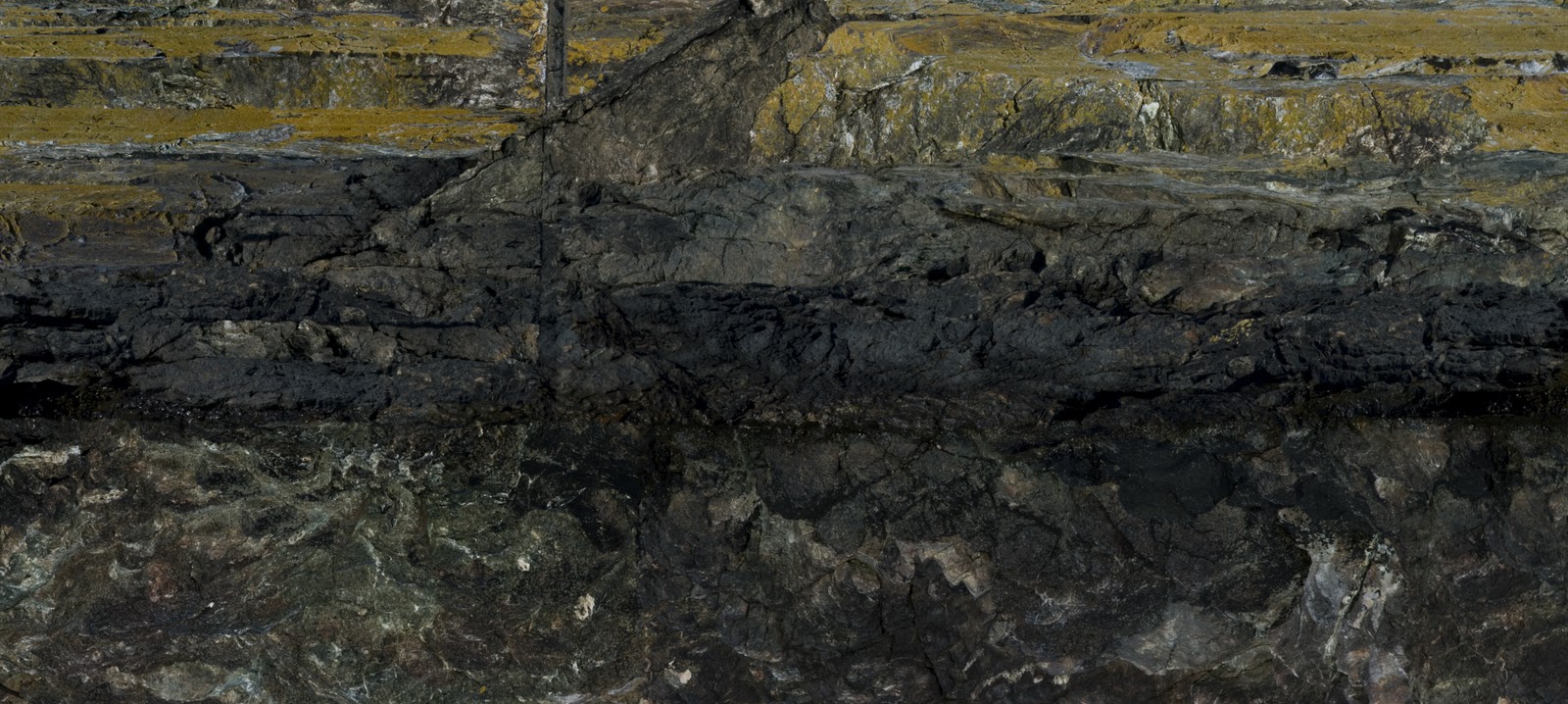
Shore rocks seemingly unhewn by human hands, coalesce into precise angularities by obscure agency.
More coming soon.
Monday, 28 November 2011
Convergent Residuals

More-or-less completed image that will be presented for third and last crit of the semester (Dec.1)
Untitled Composite

Main image presented for the second crit. (Oct.27)

I printed it big enough

taking-down hijinks
Monday, 7 November 2011
Fledgling second Bridgetown image


Here's another image I'm working on that's set in the same "Bridgetown Belt" world as the first image. Still clearly in a rough, early stage.
Sketchup makes the process interesting, I have the freedom to be slightly more automatic in filling in the blank spaces and experiment more efficiently. Even so it's pretty slow going, there's still a lot of time spent with trying to make things work that I eventually have to give up on. Even so I think it's an interesting new way to work.
I'll hit the next stage in the development of this image when all the blank spaces are fully textured. At that point I can add further textures to enhance detail and ambiance, and work on blending the lighting and colour to make the composite look less like a goblin-spawned Lego heap.
Thinking about including a foreground element to occupy about half of the open portion on the right hand side, though I'm not sure just what to use. The POV for this shot in Sketchup is from a point in open space with no large structures around, so I'm thinking about something light and movable. Maybe something attached to a crane...
Wednesday, 2 November 2011
406 Crit #1 image (Bridgetown Belt 1)
First up, here's what I presented for my first crit back at the end of September:

Feedback was generally positive, people seemed most happy with the fact that I chose components that complemented each other well enough colour and lighting-wise to give an adequately seamless impression. I was pleased to hear my professor Linda note that the stairwell leading downward did a particularly good job of opening up the world of the image to the imagination.
The main problem most people had with this image was the part that I'd been struggling to resolve from the beginning, the top-right hand portion showing the structures and land below. The difficulty of finding an adequate image to suit the extreme downward angle combined with impressive height was something I didn't manage to overcome. Instead I copped out and went with some strangely scaled trees and a rooftop of dubious perspective. In the end it just kind of compromises the integrity of the whole rest of the image.
To rectify this, I realized it would be a good idea to model the scene in 3D, which was my original plan anyway. I gave Google Sketchup a try, and after some initial hiccups I was able to get into it and model the space as well as the larger area I have in mind for the setting as a whole.


Feedback was generally positive, people seemed most happy with the fact that I chose components that complemented each other well enough colour and lighting-wise to give an adequately seamless impression. I was pleased to hear my professor Linda note that the stairwell leading downward did a particularly good job of opening up the world of the image to the imagination.
The main problem most people had with this image was the part that I'd been struggling to resolve from the beginning, the top-right hand portion showing the structures and land below. The difficulty of finding an adequate image to suit the extreme downward angle combined with impressive height was something I didn't manage to overcome. Instead I copped out and went with some strangely scaled trees and a rooftop of dubious perspective. In the end it just kind of compromises the integrity of the whole rest of the image.
To rectify this, I realized it would be a good idea to model the scene in 3D, which was my original plan anyway. I gave Google Sketchup a try, and after some initial hiccups I was able to get into it and model the space as well as the larger area I have in mind for the setting as a whole.


I quickly took to Sketchup since it would allow me to not have to worry so much about scale and perspective; I could use it to correct what I already had going and also to find perspectives from which to create new images, simply by moving through 3D space. Problem with that was I spent too much time in the program without making progress in Photoshop, which left me at a disadvantageous position leading up to the second crit last week Thursday (October 27). But more on that later. Here's where I'm at with the image at the moment:

More stuff going up shortly.
Megabyte contemplates a Null / Blog Resurrection Attempt #2

Let's see if I can manage to actually post something again. This picture is a start. It'll take several posts to catch up with what I've been up to lately, so bear with me.
Thursday, 22 September 2011
a change of perspective
Last week I had a discussion with my instructor Brad about my working process and some general limitations that I felt it would be good to break out from. One of the things that's bugged me about my previous composites, such as the Emplacement/Spectre/Object for example, is that they invariably settle into a "detatched" perspective, with no clear evidence of where the photographer is standing in relation to the whole environment. As a result there is a lack of any foreground/background dynamic, instead there is only background, a more or less flat plane.
This type of perspective works well for photographers like Edward Burtynsky and Andreas Gursky, who use grand-scale perspectives without a "grounding" foreground to render real-world places appear alien and leveled out to such a degree that abstract forms and patterns become an immediate visual highlight.

Andreas Gursky, Pyongyang V, 2007.
But when it comes to what I'm doing by creating an image of a place that doesn't exist, I think it's important to establish a clear sense of scale in order for the viewer to get a better idea of how big things are in relation to human size. I've included human figures in my composites before in hopes of accomplishing this feat, but I've found that because they are always so totally dwarfed by their surroundings, people viewing my images have often completely overlooked the fact that there are figures in them at all.


Because my end goal in making these composites is to create depictions of non-existent environments that people hopefully find interesting enough to reflect upon, I'm always striving to direct the focus towards making my images more immersive and less akin to merely an elaborate display of my Photoshop collage technique. Hopefully by widening the depth of field and including a definite foreground with my latest composite, I'll be moving closer towards that goal.
Wednesday, 21 September 2011
new composite
This is what I have so far for my newest composite, which should be completed for the crit next week Thursday (Sep. 29).


I've chosen the angle specifically so that more than half of the image is at immediate scale, the original dimensions preserved from my initial photograph. Beyond that is an adjacent building separated by a gap I'll try to bridge with flagging and/or wires. The top right portion will be open, showing the distant ground below. Hopefully I can complete at least one more composite for the crit.
Textual accompaniment will likely be significantly trimmed down by comparison to my last work. During my meeting with my instructor Brad last week, he made the point that it's important not to let the text end up doing more conceptual heavy-lifting than the actual images, lest the composites become sidelined and the text a kind of crutch to express my ideas. I think he makes a good point, and I agree that it's best if I try to communicate my ideas through the images primarily.


I've chosen the angle specifically so that more than half of the image is at immediate scale, the original dimensions preserved from my initial photograph. Beyond that is an adjacent building separated by a gap I'll try to bridge with flagging and/or wires. The top right portion will be open, showing the distant ground below. Hopefully I can complete at least one more composite for the crit.
Textual accompaniment will likely be significantly trimmed down by comparison to my last work. During my meeting with my instructor Brad last week, he made the point that it's important not to let the text end up doing more conceptual heavy-lifting than the actual images, lest the composites become sidelined and the text a kind of crutch to express my ideas. I think he makes a good point, and I agree that it's best if I try to communicate my ideas through the images primarily.
Subscribe to:
Posts (Atom)